CBC Test: Meaning, Normal Range, Cost & What It Detects
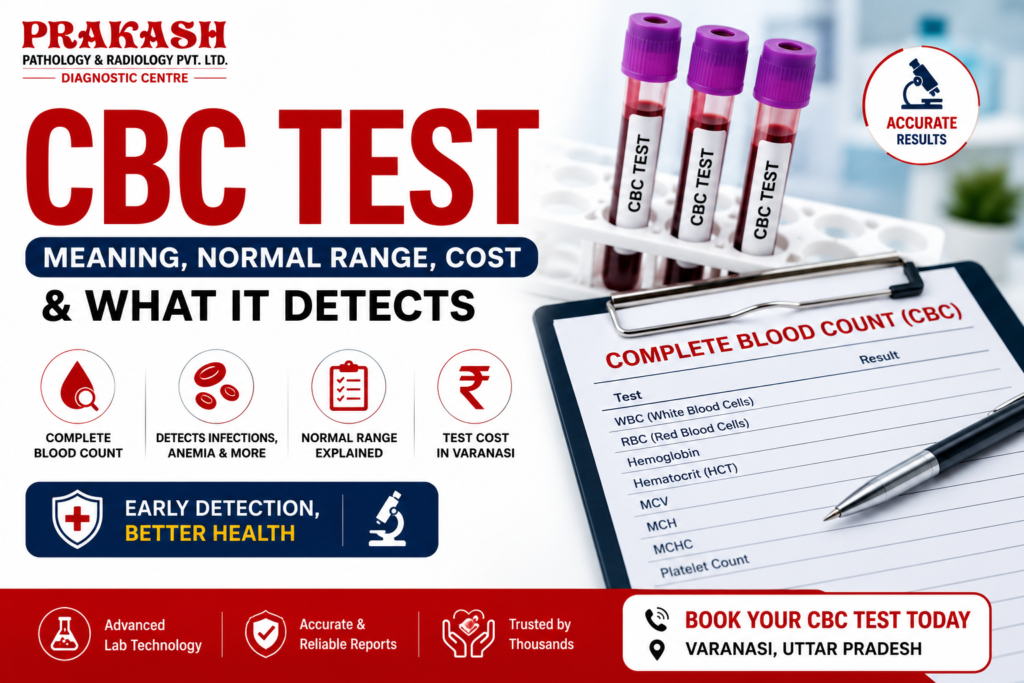
If you have ever visited a doctor for a routine health check, fever, fatigue, or unexplained weakness — there is a good chance they ordered a CBC test. It is one of the most commonly prescribed blood tests in India, and for good reason. A CBC test gives your doctor a remarkably detailed snapshot of your overall health in a single, simple blood draw. It can detect conditions ranging from anaemia and infections to blood disorders — often before you even feel significantly unwell. This guide explains everything you need to know about the CBC test — what it means, what it measures, what the normal ranges are, what conditions it can detect, and what it typically costs. What Is a CBC Test? CBC stands for Complete Blood Count. It is a blood test that measures and analyses the three main types of cells found in your blood — red blood cells, white blood cells, and platelets. Each of these cell types plays a critical role in keeping your body functioning. When any of them are too high, too low, or abnormal in structure, it signals that something in the body needs attention. The CBC test quantifies all of these cells and gives your doctor the data needed to investigate further. It is a foundational diagnostic test — simple to perform, affordable, and extraordinarily informative. What Does a CBC Test Measure? A standard CBC test measures the following parameters: Red Blood Cell (RBC) Parameters RBC Count — The total number of red blood cells in your blood. Red blood cells carry oxygen from your lungs to every cell in your body. Haemoglobin (Hb) — The protein inside red blood cells that actually binds and transports oxygen. Low haemoglobin is the primary indicator of anaemia. Haematocrit (HCT) — The percentage of your total blood volume that is made up of red blood cells. MCV (Mean Corpuscular Volume) — The average size of your red blood cells. This helps doctors identify the type of anaemia — whether it is caused by iron deficiency, vitamin B12 deficiency, or another cause. MCH and MCHC — Measures of the haemoglobin content within red blood cells, used to further characterise anaemia. RDW (Red Cell Distribution Width) — Measures variation in the size of red blood cells. A high RDW can indicate nutritional deficiencies. White Blood Cell (WBC) Parameters Total WBC Count — The total number of white blood cells, which are your body’s primary immune defenders. A high count usually indicates infection or inflammation. A very low count can suggest immune suppression. Differential Count — Breaks down the total WBC count into specific types of white blood cells: Platelet Parameters Platelet Count — Platelets are the tiny cells responsible for blood clotting. A low platelet count increases bleeding risk. A high count can indicate clotting disorders or inflammation. MPV (Mean Platelet Volume) — The average size of platelets, which can give additional information about platelet function and bone marrow activity. CBC Test Normal Range (Adults) Parameter Normal Range (Adults) RBC Count 4.5 – 5.9 million/µL (men) / 4.0 – 5.2 million/µL (women) Haemoglobin 13.5 – 17.5 g/dL (men) / 12.0 – 15.5 g/dL (women) Haematocrit 41 – 53% (men) / 36 – 46% (women) MCV 80 – 100 fL Total WBC Count 4,000 – 11,000 cells/µL Neutrophils 40 – 70% Lymphocytes 20 – 40% Eosinophils 1 – 6% Platelet Count 1,50,000 – 4,00,000/µL MPV 7.5 – 12.5 fL Important: Normal ranges can vary slightly between laboratories depending on the equipment and reference population used. Always interpret your CBC results in consultation with your doctor — not in isolation. What Can a CBC Test Detect? A CBC test is one of the most versatile diagnostic tools available. Here is what it can help identify: Anaemia The most common reason a CBC is ordered. Low haemoglobin and RBC count confirm anaemia. The MCV and MCH values then help determine the type — iron deficiency anaemia, vitamin B12 deficiency, folate deficiency, or thalassaemia. Anaemia is extremely common in India — particularly among women, children, and the elderly — and often goes undetected for years because its symptoms (fatigue, breathlessness, pale skin) are easy to dismiss. Infections An elevated WBC count — particularly neutrophils — points to a bacterial infection. An elevated lymphocyte count suggests a viral infection. The differential count helps your doctor narrow down the type and severity. Dengue and Viral Fevers A falling platelet count is one of the most important early markers in dengue fever. A CBC test is routinely ordered during fever to monitor platelet levels and detect dengue-related thrombocytopenia early. Leukaemia and Blood Cancers Abnormally high or abnormally low WBC counts — especially with abnormal cell types in the differential — can be an early indicator of leukaemia or other blood cancers. A CBC does not diagnose cancer on its own, but it flags the abnormality that prompts further investigation. Clotting Disorders A very low platelet count (thrombocytopenia) can indicate conditions like ITP (Immune Thrombocytopenic Purpura), liver disease, or bone marrow problems. A high platelet count (thrombocytosis) may indicate inflammation, infection, or a bone marrow disorder. Immune Disorders A persistently low WBC count (leukopenia) can suggest immune suppression — whether from medication, autoimmune conditions, or other underlying causes. Nutritional Deficiencies Low haemoglobin combined with a low MCV typically indicates iron deficiency. A high MCV with low haemoglobin points to vitamin B12 or folate deficiency. Both are extremely common in India and very effectively treated once identified. When Should You Get a CBC Test Done? Your doctor may order a CBC test in the following situations: Even if you feel completely well, a CBC test once a year is one of the simplest and most effective ways to stay ahead of your health. CBC Test Cost in Varanasi The cost of a CBC test in Varanasi typically ranges from ₹150 to ₹400, depending on the laboratory and whether it is part of a larger health package. At Prakash Pathology & Radiology, Varanasi, the CBC
CBC Test: Meaning, Normal Range, Cost & What It Detects Read More »